
What to Remove and Protect Before a New Stove Is Installed in Your Kitchen
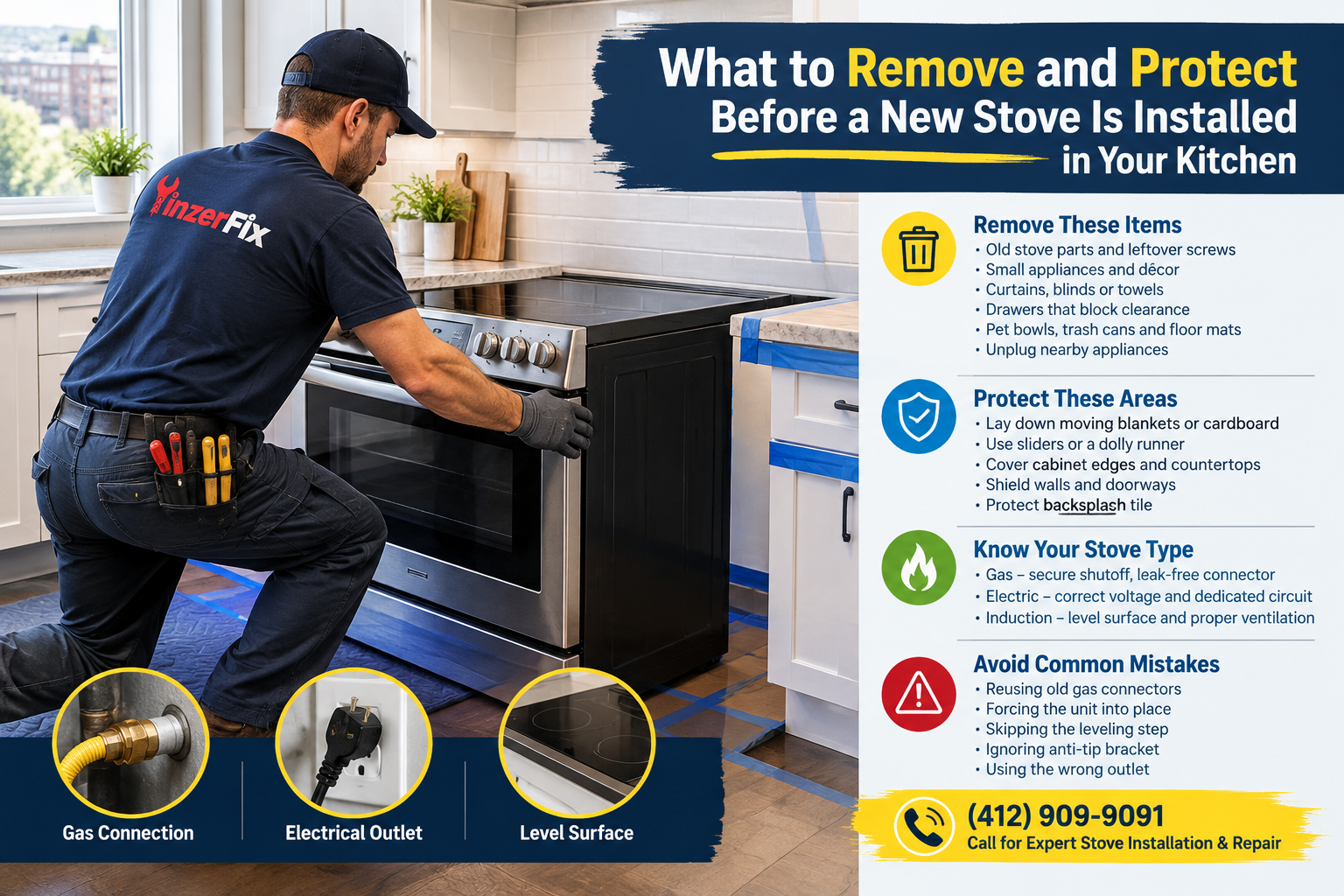
Installing a new stove sounds simple — until moving day arrives and you realize the old unit won't budge past the cabinets, or the delivery crew is standing in your kitchen while you scramble to clear counter space. For homeowners across Pittsburgh, from Squirrel Hill to Mt. Lebanon and Bellevue, a little preparation before installation day can prevent scratched floors, damaged cabinets, and the kind of connection mistakes that lead to an early service call. Here's exactly what to remove, what to protect, and what our technicians recommend before a new stove ever crosses your threshold.
Why Kitchen Prep Matters Before Installation Day
A new range or cooktop is a significant investment, and how it's installed affects how it performs for years afterward. Rushed installations are one of the more common reasons homeowners end up needing residential stove repair in Pittsburgh within the first few months — loose gas fittings, pinched power cords, or an unlevel unit can all trace back to a hurried setup. Taking 30–45 minutes to prep the space properly protects both your kitchen and your new appliance.
Items to Remove Before the Installation Crew Arrives
Clear a direct path and workspace before your installer shows up:
Remove the old stove's anti-tip bracket, connector hose, and any leftover screws
Clear countertops near the install zone of small appliances, jars, and décor
Take down curtains, blinds, or towels hanging near the range area
Remove drawers directly beneath or beside the stove if they restrict clearance
Move pet bowls, trash cans, and floor mats out of the walkway
Unplug and relocate nearby small appliances that share the same outlet or circuit
Surfaces and Areas Worth Protecting
Even careful installers can scuff a floor or bump a cabinet edge while maneuvering a heavy unit. Protect these areas ahead of time:
Lay down moving blankets or thick cardboard along the delivery path
Use furniture sliders or a dolly-friendly runner on hardwood or tile floors
Cover adjacent cabinet edges and countertop corners with painter's tape or foam guards
Shield nearby walls if the doorway or hallway is narrow
Protect backsplash tile directly behind the new unit from accidental scratches
Gas, Electric, and Induction Stoves: What Changes During Setup
Not every stove installs the same way, and knowing the differences helps you ask the right questions before the job begins.
Gas stoves need a secure shutoff valve, a leak-free flexible connector, and correct clearance from combustible materials. A loose fitting or old, brittle connector hose is one of the most frequent causes of odor complaints and follow-up repair visits.
Electric stoves rely on the outlet's voltage and amperage matching the unit's requirements — usually a dedicated 240-volt circuit. Using an outdated outlet or an undersized breaker can trip circuits repeatedly or damage internal components.
Induction stoves are the most sensitive to placement. They require adequate ventilation clearance and a flat, level surface; an uneven countertop can cause error codes or inconsistent heating almost immediately after setup.
If you're unsure which category your new unit falls into, a quick call to our team before delivery day can save a return trip later. Reach us anytime at (412) 909-9091 to confirm your outlet, gas line, or ventilation setup is ready.
Common Mistakes That Lead to Early Repair Calls
Even well-intentioned DIY installations can create problems down the road:
Reusing an old, worn gas connector instead of a new one
Forcing the unit into place without checking cabinet clearance
Skipping the leveling step, which affects even heating and self-cleaning cycles
Ignoring anti-tip bracket installation, a safety requirement for freestanding ranges
Plugging an electric range into an outlet that isn't rated for it
These oversights rarely cause an immediate issue, but they often surface within the first few weeks — usually as uneven cooking, error codes, or a faint gas smell.
When to Bring in a Professional Instead of DIY
Swapping a lightweight microwave is one thing; disconnecting a gas line or rewiring a 240-volt circuit is another. If your installation involves reworking gas piping, upgrading electrical, or fitting a stove into a custom cabinet cutout, it's worth having an experienced technician handle it. Our team provides dependable stove installation service for Pittsburgh homeowners, and if something feels off after setup — slow ignition, uneven burners, or a control panel that won't respond — we also offer same-day residential stove repair to get it corrected quickly.
Conclusion
A smooth stove installation starts before the delivery truck ever arrives. Clearing the workspace, protecting your floors and cabinets, and understanding how your specific stove type connects can prevent most of the issues that lead to a repair call down the line. If you're planning a new stove installation or something isn't performing right after setup, YinzerFix offers reliable stove repair services and installation support across Pittsburgh — call (412) 909-9091 or book online to get it done right the first time.
Frequently Asked Questions
1. Do I need to remove my old stove myself before installation?
Most installation crews can disconnect and haul away your old unit, but check with your service provider ahead of time so it's included in the visit.
2. How much clearance does a new stove need on each side?
This varies by model, but most manufacturers recommend at least a small gap on each side for ventilation and safe handling — check your unit's manual for exact specifications.
3. Can a wrong outlet damage a new electric stove?
Yes. Plugging into an outlet with the wrong voltage or an undersized circuit can trip breakers repeatedly or damage internal electrical components.
4. Is it normal to smell gas briefly after a new gas stove is installed?
A very faint, brief odor during initial startup can be normal, but a persistent smell should be checked immediately by a professional technician.
5. How soon after installation should I test all the burners or elements?
It's a good idea to test every burner, element, or induction zone within the first day so any installation issue can be addressed quickly.
Tags :
- residential stove repair Pittsburgh
- same-day residential stove repair
- reliable stove repair services
- new stove installation Pittsburgh
- stove installation checklist
- stove repair near me Pittsburgh
- appliance repair near me same day
- stove repair company near Squirrel Hill
- who fixes stoves near me
- gas stove repair near me Pittsburgh PA
- local stove repair technician Pittsburgh
- why is my stove burner not lighting
- emergency stove repair Pittsburgh
- top rated stove repair near me
- reliable appliance repair Pittsburgh reviews
- average cost to fix a gas stove burner
- stove repair vs replacement cost Pittsburgh
- is it worth fixing an old stove or buying new
- how much does stove repair cost in Pittsburgh
- residential stove repair
- residential stove
- stove repair
- reliable stove repair
- appliance repair
- kitchen appliance repair